Breed heritage
The Boran Breed
Three thousand years in the making: the indigenous beef breed of East Africa, and why it has become the cattle of choice for the African rangeland.
Indigenous to Africa
Origin
Cattle were domesticated independently in three parts of the world. The Boran descends from all three: a lineage that converged on the high plateaus of the Horn of Africa.
Bos Indicus
Indus Valley · PakistanThe humped zebu: heat-tolerant, tick-resistant, and the dominant genetic contribution to the Boran.
European Bos Taurus
Eastern EuropeThe hump-less taurine cattle that lent beef conformation and growth to the African herds they joined.
African Bos Taurus
Sub-Saharan AfricaDomesticated on the continent itself: the deepest-rooted layer of the Boran's make-up.
Cattle arrived in Africa in waves: the hump-less Hamitic Longhorns reached the Nile Delta around 6000 BC, followed by the taurine Shorthorns about 2750-2500 BC. The humped zebu first appeared as early as 2000 BC, with a second introduction arriving with the Arab expansion from around 699 AD. Each migration passed through the Borana plateau of southern Ethiopia: the crossroads where the modern breed took shape.
DNA Analysis · Hanotte et al.
The genetic make-up of the Boran
DNA sampling resolves the Boran into three ancestral proportions: a combination found in no other breed on earth.
The Boran's last infusion of new genes: not a synthetic breed crossed in recent decades.
Bred as a pure breed ever since, on the rangelands of eastern Africa.
That depth of purity gives the Boran far stronger hybrid vigour than modern compound breeds.
History
The Boran comes to South Africa.
A forty-year journey south: from one Kenyan rancher's ambition to the embryo transfers that finally made it possible.
"It is without doubt the best sight of cattle I have had the privilege to see. Given the other wonderful characteristics that the Boran have, we decided then and there to import the Boran into South Africa."
Douglas Ralfe · Nairobi, 19921960s
The first attempt
Kenyan farmer Miles Fletcher resolves to emigrate and establish a Boran herd in South Africa, moving over 100 head down to Zambia.
A door closes
Movement restrictions through Rhodesia force Fletcher to abandon the plan; his Boran are sold to Agricultural Enterprises Ltd in the Choma district, Zambia.
Embryos change everything
Fletcher's great-nephew Simon Hodgson, realising embryo transfer makes importation possible, contacts the Kenya Boran Cattle Breeders' Society.
Judging at Nairobi
Douglas Ralfe and his son Tim fly to Kenya to judge the Boran at the Nairobi Show, then spend ten days touring the prominent ranches: and are won over.
Recognised as a breed
In August the Department of Animal Improvement formally recognises the Boran as a breed in South Africa.
A society of its own
On 17 May the Boran Cattle Breeders' Society of South Africa is founded.
Why Boran
Ten reasons it earns its place on the veld.
Fertility, hardiness and an easy temperament: the qualities that make the Boran the mothering cow of Africa and a celebrated crossbreeding sire.
A unique genetic composition
Your best choice for crossbreeding: 64% Bos Indicus, 24% European and 12% African Bos Taurus, a blend found nowhere else.
The mothering cow of Africa
Good udders and well-formed teats wean calves over 50% of the dam's weight. A strong mothering instinct deters predators and lifts calf survival. Small calves: bulls average 28 kg, heifers 25 kg, mean calving problems hardly exist.
Longevity
A 15-year-old cow being sound-mouthed is quite normal; one 16-year-old bull is on record still producing high-quality semen for AI.
Fertility
The breed's greatest attribute. Even in harsh conditions the cow keeps breeding without punishing herself, losing little condition over the suckling period and conceiving again readily.
Disease resistance
A loose, motile skin with short oily hair makes a poor host for ticks and flies. Thick eye banks, long lashes and a well-formed tail switch guard against insects.
Temperament
Quiet, docile and easy to handle: a trait shaped over many generations living close to people.
Carcass quality
Nebraska trials score the Boran and its crosses consistently better than other Zebu breeds for meat tenderness, marbling and rib-eye area.
Herd instinct
A strong herd instinct makes the breed easy to manage in bush country: and makes it almost impossible to steal a single animal from a herd.
Converts roughage to beef
Fattens off the veld with no energy supplement and browses well, holding condition under difficult circumstances.
Early maturing
Boran heifers reach puberty at an average age of just 385 days.
Built for Africa, by Africa
Selected by the rangeland itself.
years of natural selection on the East African rangelands.
achievable calving interval from fertile, early-maturing females.
productive breeding lifespan, with sound feet and udders.
celebrated crossbreeding sire for hybrid vigour on commercial cows.
The breed in our herd
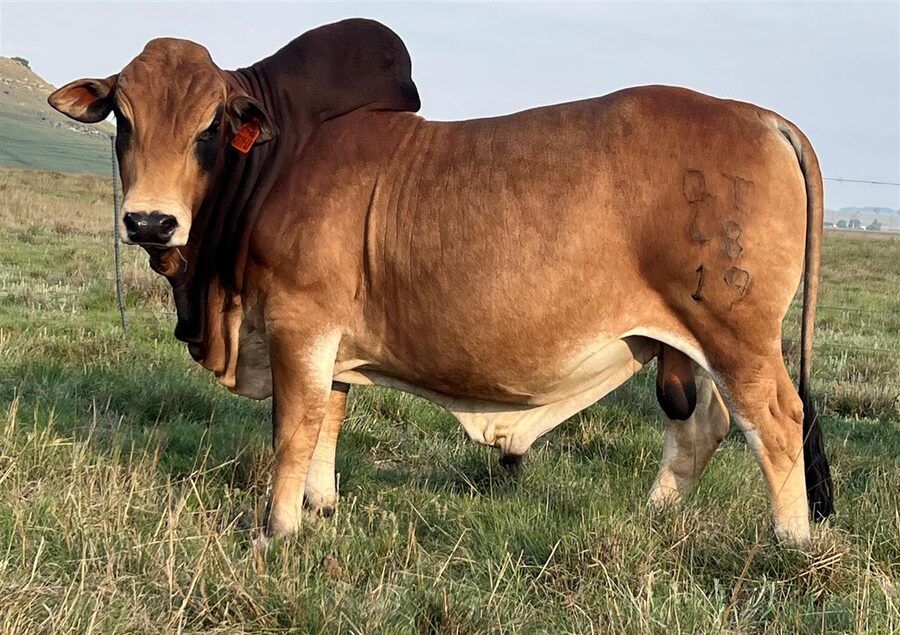
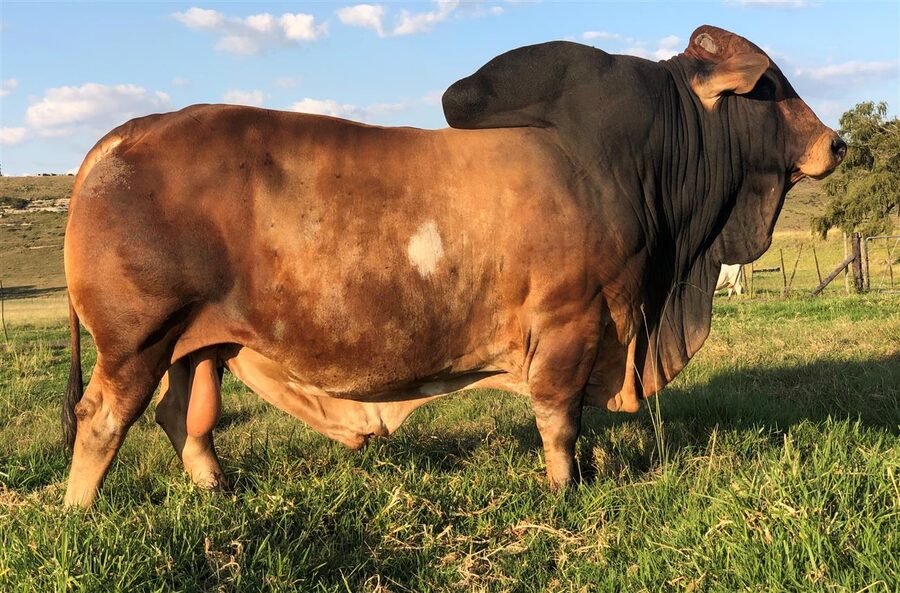
What the Boran looks like in the flesh.
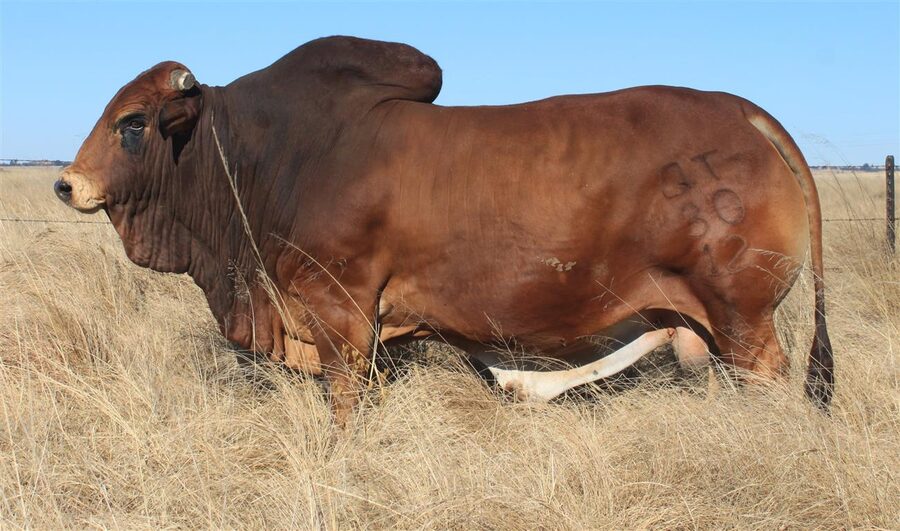
Breed standard
Standard of Excellence
The breed standard balances function and type. We select to it rigorously: an animal must be correct before it is fashionable.
Type & forequarters
A medium-framed animal with good muscling and weight for age, all parts in proportion. Strong sexual dimorphism: bulls much larger and masculine, cows smaller and feminine, both showing the typical Boran characteristics.
Compact and broad between the eyes with prominent brow ridges; small, short-haired ears; broad muzzle; strong, deep lower jaw with firm lips. Eyes, ears, muzzle and nose well pigmented. Slightly convex in profile, with a dry, clean nasal area.
Deep and relatively compact with good attachment front and back. Bulls carry a strong, thick, muscular, darkly coloured neck and a prominent dewlap over a deep, full forechest.
Deep, broad, muscular and firmly attached: though fertile cows carry somewhat looser shoulders.
Positioned directly above the front legs, rounded and well developed, blending smoothly into the body.
Body & topline
Long, broad, straight, strong and well muscled.
Broad and deep, well filled behind shoulders and elbows. Ribs well sprung, deep and backward-sloping; great abdominal capacity. From the side the middle appears square, with a deep flank.
Not large or loose; hangs at a forward angle and ends in a small, V-shaped, non-fleshy opening with good control.
Hindquarters & legs
Long from hooks to pins and broad between them, sloping about 22.5° from hip to pin: not too steep. Hip bones not prominent, well covered with muscle; pins set lower than the hooks.
Tail head not prominent; broad base sits slightly higher than the pins. Long and tapering to a large, dense, pigmented switch.
Broad and full from side and rear, extending low to the second thigh, widest at the stifle.
Wide-set and strong with good angulation: neither straight nor sickle-hocked, neither too fine nor too coarse. Medium length, proportional to the body.
Pasterns neither too upright nor too weak. Claws upright and symmetrical with straight inner edges, short deep heels, set close together and pigmented; weight even on both claws. Front legs straight; hoof crown not swollen.
Skin, organs & character
Thick, loose, flexible and preferably pigmented skin without excessive folds, carrying short, shiny, oily hair.
Well-developed udder with pigmented, medium teats; well-developed, pigmented vulva. Scrotum large with a thin neck, not hanging much below the hock; testicles equal, the sac soft, smooth, short-haired and pigmented, especially at the tip.
Comfortable and springy, legs and feet remaining parallel: not turning inward or outward.
Calm, manageable and even-tempered.
Our heritage
The stud's story
The stud was founded in 2007. A close friend, Schalk van Oudtshoorn, a Boran breeder, first introduced us to the breed, and we immediately knew the Boran was something special.
It is a beautiful animal, but it was the breed's potential for the South African cattle industry that impressed us most. The combination of qualities found in the Boran is something not easily found in any one breed.
After much research we realised these cattle cannot simply be bought on any sale, and that their prices made them hard for commercial breeders to acquire. To meet that need we decided to buy registered Boran embryo donors exclusively for the supply of embryos: and that meant buying the best, most fertile genetics we could get.
We attended the 2007 National Boran Sale and bought our first cow from the well-known Heavitree stud. We then began an embryo-flushing programme at Embryo Plus in Brits in March 2008, selling all grade-1 embryos and implanting grade-2 and grade-3 embryos into recipient cows. Our policy is to get our females back in calf after flushing them three to four times consecutively.
We strive to breed a good-looking, functional, efficient Boran: with fertility, growth, good conversion of roughage into quality meat, sound temperament, disease resistance and longevity as its defining characteristics.
- B04-064 2007 Boran Genetics Sale · imported Kenyan embryosR155 000
- B05-90 2007 Boran Genetics Sale · in-calf heiferR125 000
- TLM 03-56 2008 National SaleR140 000
- B05-123 2008 Boran Genetics Sale · imported embryosR122 000